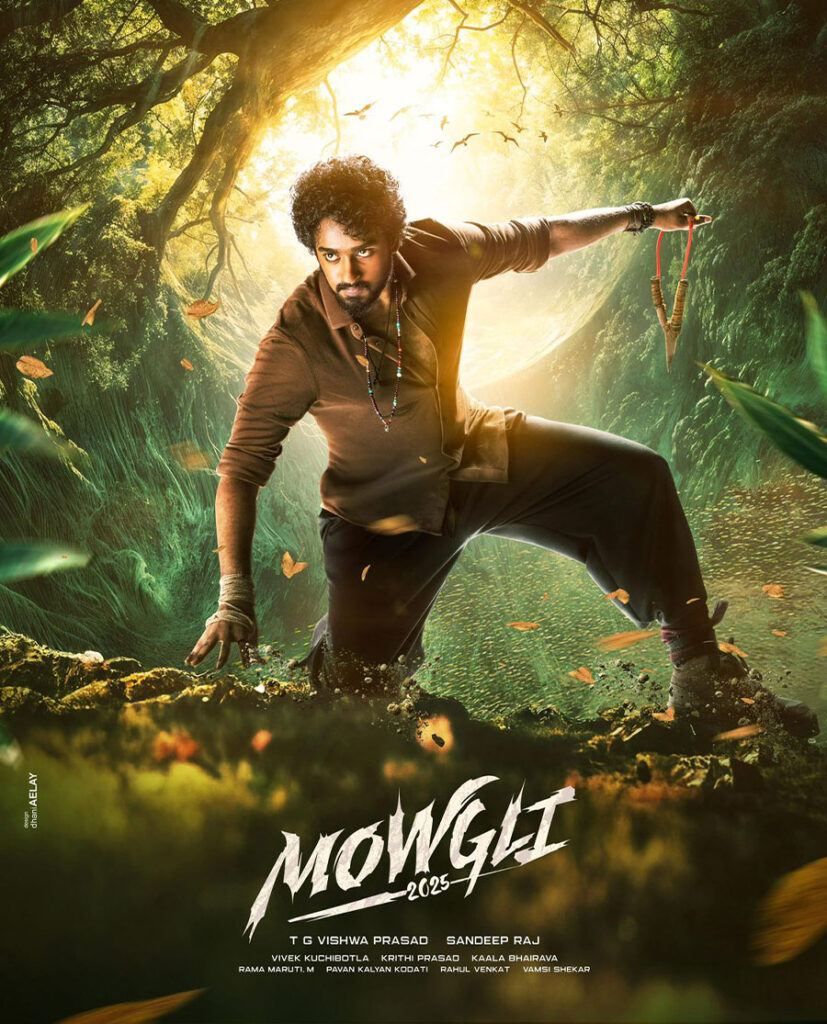
Mowgli
Set in a raw rural backdrop, Mowgli follows a rebellious young man driven by anger and survival instincts as he navigates violence, loyalty, and self-identity, portraying a dark, intense journey shaped by circumstances rather than choice.
Table of Contents
ToggleMowgli: A romantic action drama set against a forest backdrop where a young man fights for love and survival in the face of ruthless opposition.
Mowgli is a bold and intense film that showcases Sandeep Raj’s realistic storytelling and emotional depth.
Mowgli Movie Review Rating:
Star Cast: Roshan Kanakala, Sakshi Mhadolkar, Bandi Saroj Kumar, Harsha Chemudu.
Director: Sandeep Raj
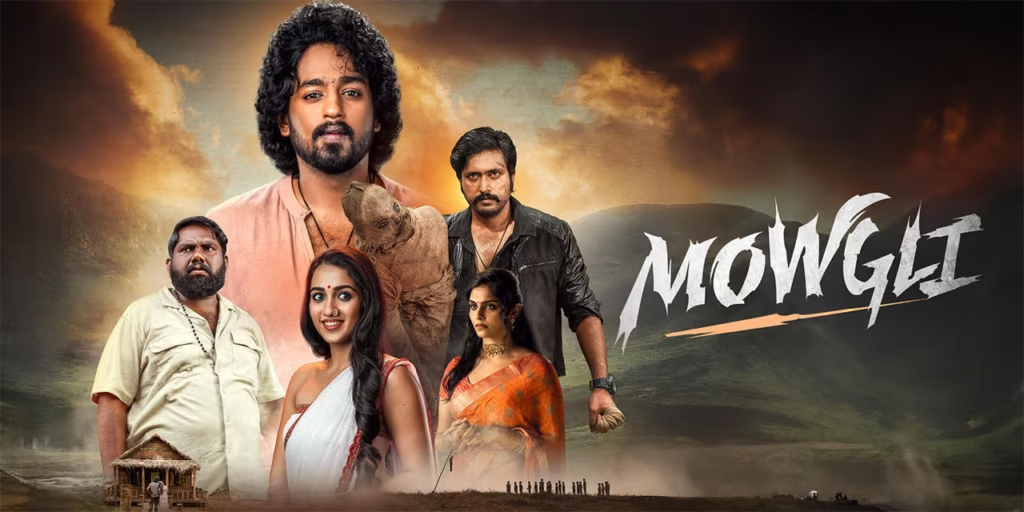
What’s Good: Hard-hitting narration, realistic characters, strong emotions, natural performances, engaging screenplay.
What’s Bad: Slow pacing in parts, not a typical commercial entertainer.
Loo Break: No – the narrative keeps you emotionally invested.
Watch or Not?: Must watch if you enjoy realistic Telugu cinema and content-driven films.
Language: Telugu.
Available On: Theatrical release
Runtime: 2 Hours 05 Minutes
User Rating Clickflik.in:
Rate This:
Mowgli is a raw and emotional Telugu film that blends romance, survival, violence, and innocence against a dense forest backdrop. Directed by Sandeep Raj, the film moves away from urban storytelling and commercial gloss, choosing instead a rugged world where love, power, and brutality collide. The story is grounded in human emotions but told through a wild, almost primal lens, making Mowgli a striking cinematic experience.
The film introduces us to Mowgli, a young man who lives close to nature and feels more at home in the forest than in civilised society. He is fearless, impulsive, and deeply loyal, shaped by hardship rather than comfort. From the opening scenes, the film establishes his bond with the wilderness, portraying it not just as a location but as a living force that protects, challenges, and defines him. Mowgli’s character is written as someone who survives by instinct, not rules.
Parallel to Mowgli’s wild nature is his love interest, a gentle and innocent young woman who is deaf and mute. Her character brings emotional softness to the otherwise harsh world of the film. Their love is pure, silent, and deeply emotional, communicated through expressions, gestures, and shared moments rather than words. This relationship becomes the emotional backbone of the narrative, contrasting sharply with the violence and cruelty surrounding them.
As the story unfolds, the couple’s peaceful existence is shattered by the arrival of a brutal forest officer, the primary antagonist of the film. He represents authority without humanity, power without empathy. His cruelty towards villagers, forest dwellers, and women establishes him as a terrifying presence. The conflict between Mowgli and this officer is not just personal but symbolic — nature versus corruption, innocence versus brutality, freedom versus control.
The officer’s obsession with domination and exploitation creates a growing tension in the forest region. Villagers live in fear, unable to speak out against his crimes. The film carefully depicts how power structures silence the weak, making Mowgli’s resistance feel both dangerous and heroic. Unlike typical commercial heroes, Mowgli does not plan rebellion; his actions are driven purely by instinct and love.
When the antagonist sets his sights on Mowgli’s beloved, the film takes a darker turn. What follows is not a conventional romantic drama but a survival story where love becomes the reason to fight, bleed, and endure unimaginable pain. Mowgli’s transformation begins here — from a carefree forest boy to a fierce protector willing to challenge death itself.
The narrative intensifies as violence escalates. Mowgli is pushed to his limits physically and emotionally. The forest becomes a battleground, and survival becomes the only goal. The film does not glorify violence but presents it in a raw, uncomfortable manner, making the audience feel the weight of every action. Each injury, each loss, carries emotional consequences.
One of the most compelling aspects of Mowgli is its refusal to offer easy victories. The protagonist suffers deeply, both in body and soul. His love story is tested repeatedly, and the film explores how innocence can survive in a world filled with cruelty. The silent strength of the female lead adds immense emotional depth, as her suffering speaks louder than dialogue ever could.
As the conflict reaches its peak, the film shifts into a tense, edge-of-the-seat survival mode. Mowgli uses the forest as his ally, turning his understanding of nature into a weapon against his enemies. These sequences highlight the director’s vision — the forest is not just scenery but a living character that responds to pain, anger, and justice.
The climax is intense, brutal, and emotionally charged. Rather than offering a grand heroic victory, the film chooses realism. The confrontation between Mowgli and the antagonist is messy, painful, and morally complex. Victory comes at a cost, reinforcing the film’s central idea that survival often demands sacrifice.
In its final moments, Mowgli slows down, allowing emotions to settle. The ending is bittersweet, reflecting the journey the characters have endured. Love remains central, but it is no longer innocent — it is shaped by loss, trauma, and resilience. The film closes on a note that emphasises endurance rather than triumph.
Thematically, Mowgli explores power abuse, social silence, primal love, and survival instinct. It questions what civilisation truly means when those in authority behave like predators. By placing a silent woman and a wild man at the centre, the film amplifies voices that are usually unheard in mainstream cinema.
Sandeep Raj’s storytelling is bold and uncompromising. The film does not aim to please everyone. Its pacing is deliberate, its tone dark, and its emotions intense. Viewers expecting commercial entertainment may find it disturbing, but those who appreciate grounded, emotionally driven cinema will find Mowgli deeply impactful.
In conclusion, Mowgli is not just a love story or an action drama — it is a survival tale told with emotional honesty and raw intensity. It challenges the audience to confront uncomfortable truths about power, violence, and humanity. With its strong characters, haunting atmosphere, and emotionally charged narrative, Mowgli stands as a bold and distinctive film in contemporary Telugu cinema.
 (No Ratings Yet)
 Loading...
Mowgli Movie Review: Script Analysis
The script of Mowgli is bold, intense, and emotionally raw, reflecting director Sandeep Raj’s decision to step away from soft romantic dramas into darker, more primal storytelling. From the very beginning, the screenplay establishes a world where survival outweighs comfort and emotions are expressed through actions rather than words. The narrative is built around instinct, silence, and violence, making it a challenging yet impactful cinematic experience.
One of the strongest aspects of the script is its setting-driven storytelling. The forest is not just a background location but a central narrative force. The screenplay treats nature as a living, breathing entity that shapes characters and outcomes. Scenes are written in a way where silence, darkness, and space speak louder than dialogue. This approach gives the film a distinct identity and immediately separates it from conventional Telugu commercial cinema.
The protagonist, Mowgli, is written as a man guided by instinct rather than logic. The script does not spend time justifying his behaviour through long backstories. Instead, his personality is revealed through actions — how he moves in the forest, how he reacts to danger, and how fiercely he protects what he loves. This minimalist character writing works effectively, allowing the audience to understand him without exposition-heavy scenes.
A major strength of the screenplay is its emotional contrast. On one side, there is extreme brutality represented by the antagonist, and on the other, pure innocence embodied by the deaf and mute female lead. The decision to make the female character speechless is a powerful script choice. It amplifies vulnerability while also demanding expressive storytelling through visuals and performance. The script smartly uses this silence to intensify emotional impact rather than treating it as a weakness.
The antagonist is written with disturbing clarity. He is not a typical loud villain but a representation of unchecked power and cruelty. The screenplay avoids caricature and instead portrays him as frighteningly realistic. His actions are meant to disturb, not entertain, and this choice makes the conflict feel genuine. The script does not try to make him stylish or charismatic, which strengthens the moral weight of the story.
Structurally, Mowgli follows a linear narrative, but its emotional trajectory is nonlinear. The first act focuses on atmosphere and character establishment rather than plot progression. This slow-burning introduction may test audience patience, but it is necessary to absorb the world and understand the emotional stakes. The screenplay prioritises mood over momentum in this phase.
The second act is where the script becomes emotionally heavy. Conflict escalates not through dramatic twists but through continuous oppression and suffering. The screenplay repeatedly places the protagonist in morally and physically exhausting situations, emphasizing how survival often involves endurance rather than heroics. This repetitive structure is intentional but slightly affects pacing. Some scenes deliver similar emotional beats, which could have been tightened.
A standout element of the script is its visual storytelling. Many crucial moments are written to unfold without dialogue. The screenplay relies on body language, facial expressions, and environmental cues. This choice demands high-quality direction and performances, but when executed well, it creates a haunting cinematic language. The forest sounds, silence, and darkness are used as narrative tools rather than aesthetic choices.
The romantic arc in the script is understated yet powerful. Love is not expressed through songs or dramatic declarations but through protection, care, and sacrifice. This grounded portrayal strengthens the emotional core of the film. The screenplay ensures that the love story never overshadows the survival narrative but instead fuels it.
As the story moves towards the climax, the script becomes more visceral. Violence is presented without glamour. Injuries hurt, losses scar, and victories come at a cost. This realism strengthens thematic consistency but limits mass appeal. The screenplay intentionally avoids cathartic heroism, choosing emotional truth instead.
The climax itself is raw and uncomfortable. It does not offer clean resolutions or moral satisfaction. The script suggests that justice is messy and survival is never free. This choice aligns with the film’s tone but may divide audiences expecting a conventional payoff. However, from a writing standpoint, it reflects courage and clarity of vision.
The ending is subdued and emotionally heavy. Instead of concluding with triumph, the script focuses on the emotional aftermath. The protagonist is changed forever, and the film allows space for that transformation to settle. This restraint adds depth and avoids emotional manipulation.
Thematically, the script explores abuse of power, silence of the oppressed, primal instinct, and survival-driven love. It questions the idea of civilisation by contrasting human cruelty with natural order. The screenplay suggests that true savagery lies not in the forest but in human authority corrupted by power.
One limitation of the script is its narrow narrative focus. There are very few subplots or supporting arcs. While this strengthens intensity, it also limits narrative diversity. Viewers seeking layered storytelling may find the script emotionally draining due to its single-minded tone.
In conclusion, the script of Mowgli is fearless, emotionally intense, and visually driven. It sacrifices commercial comfort for narrative honesty. While pacing and repetition may affect accessibility, the screenplay succeeds in delivering a powerful survival drama rooted in instinct, love, and resistance. Sandeep Raj’s writing reflects maturity and confidence, making Mowgli a bold and uncompromising script in modern Telugu cinema.
Mowgli Movie Review: Star Performance
The performances in Mowgli play a crucial role in shaping the film’s emotional intensity and raw realism. Director Sandeep Raj relies heavily on his actors to communicate emotions through expressions, physicality, and silence rather than dialogue. As a result, the film stands as a performance-driven experience where each major character leaves a strong impression.
Roshan Kanakala as Mowgli
Roshan Kanakala delivers one of the most physically demanding and emotionally intense performances of his career as Mowgli. From the moment he appears on screen, he embodies the wildness and unpredictability of a man shaped by nature rather than society. His body language, aggressive posture, and piercing gaze establish his character even before he speaks.
What stands out in Roshan’s performance is his commitment to realism. He avoids heroic mannerisms and instead portrays Mowgli as a raw, impulsive survivor. His expressions shift naturally from tenderness to rage, making his emotional transitions believable. In action and confrontation scenes, Roshan uses physical intensity rather than stylized movements, which adds authenticity to the violence depicted.
Emotionally, Roshan shines in moments of vulnerability. His silent scenes with the female lead reveal a softer side of Mowgli, showing his capacity for love and protection. These scenes rely heavily on eye contact and subtle gestures, and Roshan handles them with maturity. His performance carries the film’s emotional weight and keeps the audience invested even during slow-paced sequences.
Sakkshi Mhadolkar as the Female Lead
Sakkshi Mhadolkar delivers a deeply moving performance as the deaf and mute female lead. Her role is arguably the most challenging in the film, as it demands emotional expression without dialogue. She uses facial expressions, body language, and silence to convey fear, love, pain, and resilience.
Sakkshi’s innocence brings emotional balance to the film’s brutality. Her chemistry with Roshan feels natural and unforced, built on quiet moments rather than dramatic scenes. She effectively communicates vulnerability without appearing weak, making her character emotionally powerful. Her performance plays a crucial role in amplifying the film’s emotional impact.
Some of the film’s most heartbreaking moments come from her reactions rather than actions. The pain in her eyes during moments of suffering lingers long after the scene ends. Sakkshi proves that strong performances do not require heavy dialogue, making her role one of the most memorable aspects of Mowgli.
The Antagonist’s Performance
The actor portraying the antagonist delivers a chilling and unsettling performance. Instead of playing the villain as loud or exaggerated, he chooses restraint, making his cruelty more disturbing. His calm demeanor and cold expressions enhance the sense of danger, portraying authority corrupted by power.
The antagonist’s presence creates constant tension. His scenes are uncomfortable by design, and the actor embraces this without trying to soften the character. The performance avoids sympathy or justification, making the villain a symbol of systemic abuse rather than a personal enemy. This approach strengthens the film’s thematic depth.
Supporting Cast Performances
The supporting cast adds texture and realism to the film’s world. Villagers, forest dwellers, and minor characters feel authentic rather than staged. Their natural performances enhance the grounded tone of the narrative. None of them overact or distract from the main storyline.
Harsha Chemudu appears in a role that subtly balances the film’s intensity. While known for comedy, he restrains himself here, adding lightness without breaking the film’s serious tone. His performance offers brief emotional relief while staying consistent with the narrative.
Bandi Saroj Kumar and other supporting actors bring credibility to their roles. Their interactions with the protagonist feel organic, reinforcing the film’s realism. The absence of theatrical performances helps maintain tonal consistency throughout the film.
Performance Through Silence and Physicality
One of the film’s defining strengths is its reliance on non-verbal performances. Many emotional peaks are achieved through silence, facial expressions, and physical reactions. This places immense responsibility on the actors, especially Roshan and Sakkshi, and they rise to the challenge.
Action scenes are not choreographed for spectacle but for impact. The actors sell pain, exhaustion, and fear convincingly. This commitment enhances immersion and prevents the violence from feeling artificial or glorified.
Overall Performance Impact
Mowgli succeeds largely because of its performances. The actors fully commit to the director’s vision, embracing discomfort and emotional intensity. There is no star-driven arrogance or forced elevation. Instead, performances feel honest, raw, and immersive.
The chemistry between the lead pair anchors the film emotionally, while the antagonist’s performance sustains tension. Supporting actors enrich the setting without overshadowing the narrative. Together, these performances elevate the film beyond its simple storyline.
Final Verdict on Performances
The performances in Mowgli are bold, restrained, and emotionally powerful. Roshan Kanakala delivers a standout lead performance, supported brilliantly by Sakkshi Mhadolkar’s silent yet expressive role. The antagonist and supporting cast strengthen the film’s realism, making Mowgli a performance-driven cinematic experience.
Overall, Mowgli proves that strong acting, when paired with honest storytelling, can create a lasting emotional impact without relying on commercial clichés.