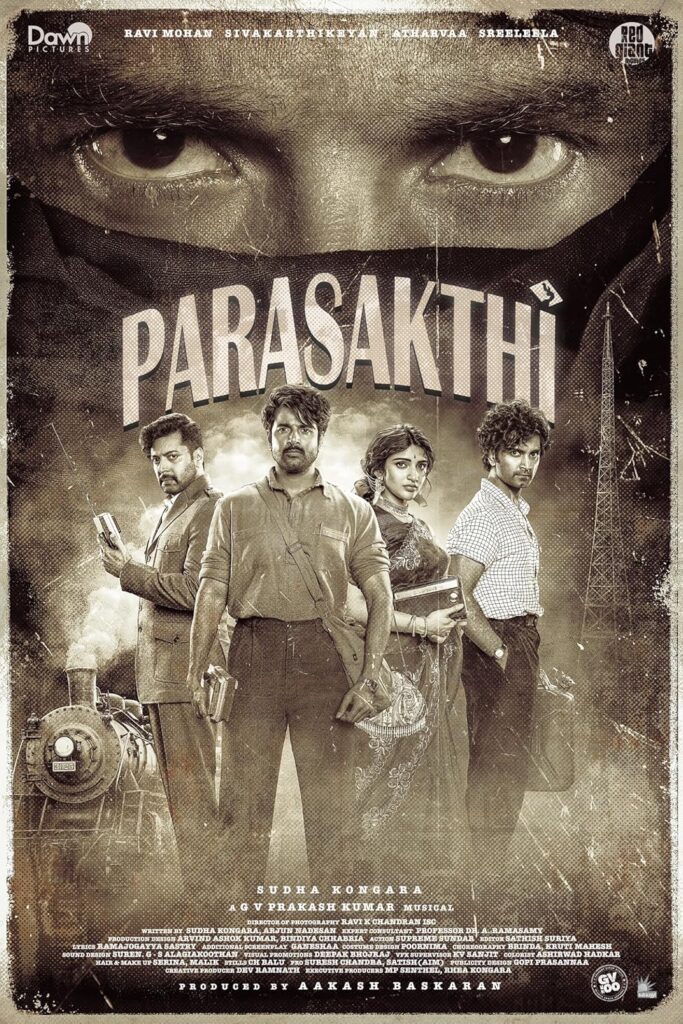
Parasakthi
A gripping period political drama about courage, protest and identity set against the 1960s Tamil anti-Hindi agitation.
Table of Contents
ToggleParasakthi: A bold historical drama with strong themes, earnest performances, and a spirited but uneven narrative.
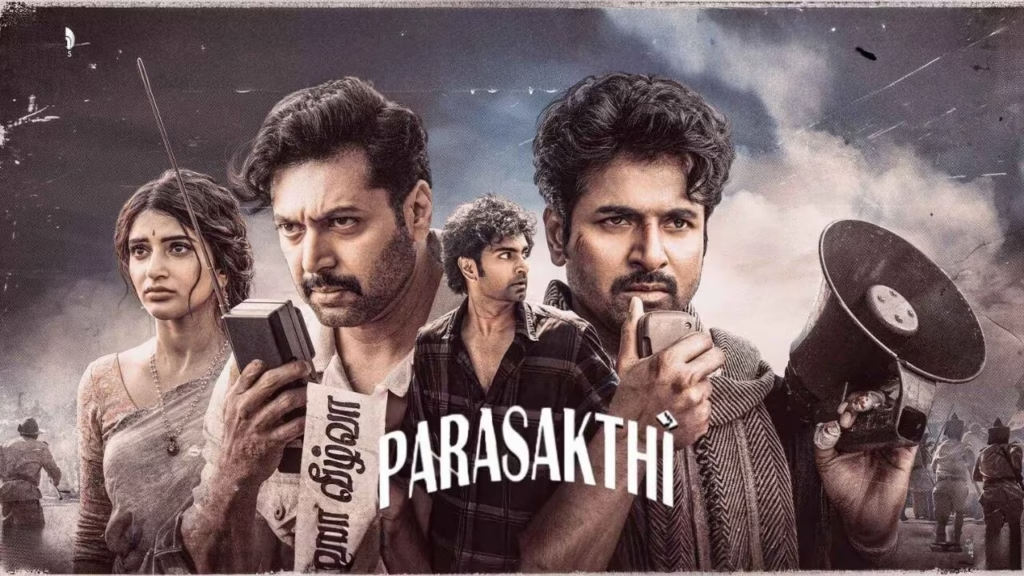
Parasakthi follows two brothers caught in the 1965 anti-Hindi imposition movement in Tamil Nadu, revealing their evolving beliefs, sacrifices and struggles during a tumultuous political era.
Parasakthi Movie Review Rating:
Star Cast: Sivakarthikeyan, Ravi Mohan, Atharvaa, Sreeleela, Dev Ramnath, Prithvi Rajanm, Guru Somasundaram, Basil Joseph, Papri Ghosh
Director: Sudha Kongara
What’s Good: Strong historical and political backdrop.
What’s Bad: Romance and emotional tracks feel underdeveloped.
Watch or Not?: Yes for history-drama fans and those who enjoy socially charged cinema; maybe skip if you prefer light entertainment.
Language: Telugu.
Available On: Theatrical release
Runtime: 2 Hours 43 Minutes
User Rating Clickflik.in:
Rate This:
Parasakthi is a powerful social drama that stands as one of the most influential films in Indian cinema, using strong storytelling, emotionally charged characters, and fearless dialogues to expose social injustice, blind faith, and the struggles of the common man in post-independence India. The story follows the life of Gunasekaran, a brave and idealistic young man who leaves his home to fight for the country during World War II, carrying dreams of returning to a peaceful and hopeful life, but fate has very different plans waiting for him. After the war, Gunasekaran returns to India only to find himself lost in a harsh and unfamiliar society where hunger, corruption, and exploitation dominate everyday life. Separated from his family due to tragic circumstances, he begins a painful journey of survival in a city that shows little mercy to the poor and the helpless. As he struggles to find his brothers and adjust to civilian life, Gunasekaran witnesses the dark realities of society, where religious institutions meant to protect people instead exploit them, and where morality is often sacrificed for personal gain. The film boldly questions blind devotion and the misuse of religion, presenting scenes that were revolutionary for their time and still feel relevant today. One of the most emotionally moving aspects of Parasakthi is the suffering faced by Gunasekaran’s family, especially the women, whose lives reflect the cruel treatment of widows, the lack of dignity for women, and the social pressures imposed by tradition. His sister Kalyani’s tragic journey becomes a mirror of society’s failure, showing how an innocent woman is pushed into unbearable situations due to poverty, hypocrisy, and lack of support. Through Gunasekaran’s eyes, the audience experiences anger, frustration, and helplessness as he repeatedly confronts injustice but refuses to surrender his voice or his principles. The courtroom sequence becomes the heart of the film, where Gunasekaran delivers a fiery speech that exposes the falsehoods hidden behind religious rituals and challenges society to value humanity over blind belief, making it one of the most iconic moments in Indian cinema history. His words are not just dialogue but a wake-up call, demanding social reform, rational thinking, and compassion for fellow human beings. The narrative skillfully balances personal tragedy with larger social commentary, ensuring that the message never feels detached from the characters’ emotional journeys. The film portrays poverty with brutal honesty, showing hunger, homelessness, and despair without exaggeration, making the audience deeply empathise with those trapped in such conditions. At the same time, Parasakthi celebrates resilience, courage, and the power of questioning authority, presenting Gunasekaran not as a flawless hero but as a deeply human character shaped by suffering and conviction. The supporting characters add depth to the story, representing different faces of society, from opportunists who exploit religion to helpless individuals crushed by circumstances. Music and songs are woven meaningfully into the narrative, enhancing emotions rather than interrupting the flow, while the background score reinforces the seriousness of the film’s themes. The direction maintains a grounded and realistic tone, allowing the performances and dialogues to carry the weight of the story. Sivaji Ganesan’s performance as Gunasekaran is legendary, delivering intense expressions and powerful monologues that remain unmatched, marking the arrival of one of Indian cinema’s greatest actors. His ability to convey pain, anger, compassion, and hope makes the character unforgettable and deeply impactful. The film’s boldness lies in its refusal to sugarcoat reality, instead choosing to confront uncomfortable truths head-on, even at the risk of controversy. As the story progresses, Parasakthi transforms from a tale of one man’s suffering into a larger voice for social reform, urging people to think rationally, stand against injustice, and treat fellow humans with dignity. The climax reinforces the idea that true devotion lies not in rituals or symbols but in kindness, equality, and moral responsibility. By the end, Parasakthi leaves a lasting impression, not just as a film but as a social statement that challenged norms and inspired generations to question, think, and speak up. Even decades after its release, the film remains relevant, powerful, and emotionally stirring, proving that meaningful cinema can entertain while also driving change. Parasakthi is not just a movie but a movement, a voice of truth that continues to echo through time, reminding audiences that humanity must always come before blind belief and silence must never replace justice.
 (No Ratings Yet)
 Loading...
Parasakthi Movie Review: Script Analysis
The script of Parasakthi stands as one of the most powerful and revolutionary screenplays in Indian cinema because it uses cinema not just as entertainment but as a strong voice for social reform, from the very beginning the narrative places the audience in a world scarred by war poverty and moral decay and immediately sets a serious tone that distinguishes it from conventional films of its time, the story follows the journey of a young man returning home after World War II only to find his family destroyed by social injustice religious hypocrisy and economic exploitation, this personal journey is cleverly used as a lens to examine larger societal problems, the brilliance of the Parasakthi script lies in how it transforms individual suffering into a broader critique of society, every major event in the screenplay is designed to expose a flaw in the system whether it is blind faith caste discrimination or the exploitation of women, the protagonist is not introduced as a heroic figure in the traditional sense but as an ordinary man pushed to the edge by circumstances which makes his anger and rebellion feel authentic and justified, the screenplay avoids glorifying violence or revenge and instead focuses on ideological confrontation through words situations and moral dilemmas, one of the strongest aspects of the script is its dialogue which functions as the backbone of the film, the dialogues are sharp bold and unapologetic directly questioning long held beliefs and practices, rather than subtle hints the script chooses clarity and courage making its message impossible to ignore, this approach was radical for its time and is a key reason why Parasakthi remains impactful even decades later, the female characters in the script are written with deep empathy and realism portraying their vulnerability within a patriarchal society while also highlighting their resilience, the suffering of the protagonist’s sister is not used merely as a plot device but as a powerful commentary on how society fails to protect its most vulnerable members, the script uses her story to expose the cruelty hidden beneath so called moral structures, another remarkable element of the screenplay is how religion is portrayed not as faith itself but as an institution corrupted by selfish individuals, the writer carefully separates true belief from exploitation and this distinction adds intellectual depth to the narrative, the courtroom scenes in Parasakthi serve as the ideological climax of the script where the protagonist’s voice becomes the voice of the oppressed, these scenes are written with extraordinary conviction using logical arguments emotional appeal and moral reasoning to dismantle false authority, the courtroom monologue is not just dramatic but philosophical challenging the audience to think rather than simply react, structurally the script is tight and purposeful with no scene feeling unnecessary as each moment contributes either to character development or thematic progression, even moments of silence and despair are meaningful reinforcing the emotional weight of the story, the pacing is deliberate allowing the audience to absorb the gravity of events rather than rushing toward resolution, the transformation of the protagonist is handled with restraint as he does not suddenly become a revolutionary figure but grows through pain observation and experience, this gradual evolution makes his final stand feel earned and powerful, the script’s strength also lies in its moral ambiguity as it does not offer easy solutions but instead raises uncomfortable questions about responsibility society and justice, the ending avoids conventional closure and instead leaves the audience reflecting on the ideas presented throughout the film, Parasakthi’s screenplay is not designed to please everyone but to provoke thought and discussion which is the hallmark of impactful writing, even today the script feels relevant because the issues it addresses are universal and timeless, social inequality misuse of power and the struggle for human dignity remain pressing concerns, the fearless nature of the writing combined with emotional sincerity makes Parasakthi more than just a film it becomes a social document, overall the script of Parasakthi is a masterclass in using cinema as a medium for meaningful change blending strong character arcs powerful dialogue and bold themes into a cohesive narrative that challenges the audience intellectually and emotionally, its legacy endures because it dared to question the status quo and trusted the audience to engage with complex ideas, making it one of the most influential and respected screenplays in Indian film history.
Parasakthi Movie Review: Star Performance
The star performance in Parasakthi is the soul of the film and the primary reason it continues to be remembered as one of the most powerful and influential performances in Indian cinema, with Sivaji Ganesan delivering a career-defining portrayal that goes far beyond conventional acting and transforms into a forceful expression of emotion, ideology, and human suffering, as his performance is not merely about dialogue delivery or screen presence but about embodying the anguish, anger, compassion, and resilience of a man shaped by social injustice, war, poverty, and moral conflict, and from his very first appearance, Sivaji commands attention with his intense eyes, sharp voice modulation, and expressive face, instantly establishing a character who is deeply affected by the world around him, and his ability to shift seamlessly between vulnerability and rage makes the character feel painfully real and emotionally gripping, especially in scenes where he confronts social hypocrisy, blind faith, and exploitation, where his words strike like thunder yet remain rooted in genuine emotion rather than artificial dramatics, and one of the greatest strengths of Sivaji’s performance lies in his dialogue delivery, which is widely regarded as revolutionary for its time, as every line is delivered with clarity, rhythm, and emotional conviction, turning conversations into powerful statements that resonate far beyond the screen, and instead of sounding theatrical, his dialogues feel like the natural outpouring of a wounded soul demanding justice and dignity, and his voice becomes a weapon that exposes societal flaws while also reflecting deep inner pain, and in emotional scenes, Sivaji showcases extraordinary restraint, allowing silence, trembling expressions, and moist eyes to convey grief more effectively than words, particularly in moments involving family loss, hunger, and betrayal, where his pain feels personal and universal at the same time, and his portrayal of suffering never feels exaggerated but deeply human, making audiences empathize with his struggles regardless of background or beliefs, and his physicality also plays a crucial role in enhancing the performance, as his posture, movement, and facial tension change according to the emotional state of the character, showing exhaustion, anger, hope, and determination without the need for explicit explanation, and his transformation across the film feels organic, as the character evolves from a broken individual into a voice of resistance, and Sivaji captures this journey with remarkable control and emotional depth, making the character’s growth believable and impactful, and the supporting cast complements his performance effectively, with actors like S. S. Rajendran and Pandari Bai delivering strong performances that enhance the emotional weight of the story, especially in scenes that involve ideological conflict and emotional confrontation, where Sivaji’s performance shines even brighter due to the solid reactions and presence of the actors around him, and the female characters add emotional grounding to the narrative, with their performances reflecting sacrifice, compassion, and suffering, which further amplify the impact of Sivaji’s emotional outbursts and ideological stands, and the antagonist figures in the film are portrayed in a way that allows Sivaji’s character to challenge them not just physically but intellectually and morally, resulting in confrontations that feel meaningful and thought-provoking rather than routine, and the director’s vision plays a significant role in shaping these performances, as actors are given space to express emotions fully without rushing scenes, allowing Sivaji to explore the depth of each moment, especially in courtroom-like confrontations, public speeches, and intimate emotional exchanges, and the film’s ideological core is carried almost entirely on Sivaji’s shoulders, yet he never lets the message overpower the human aspect of the character, maintaining a perfect balance between social commentary and emotional storytelling, and what makes his performance truly timeless is its honesty, as there is no sense of artificial heroism or forced dramatization, only a man reacting to injustice with pain, anger, and courage, and this sincerity is what connects the film across generations, making the performance relevant even decades after its release, and overall, the star performance in Parasakthi stands as a benchmark in Indian cinema, with Sivaji Ganesan delivering an unforgettable portrayal that combines powerful dialogue delivery, emotional authenticity, ideological intensity, and exceptional screen presence, creating a character that is not just remembered but revered, and his performance transforms Parasakthi from a film into a cultural movement, proving that strong acting can challenge mindsets, inspire thought, and leave a lasting impact far beyond entertainment.